Showing posts with label History. Show all posts

Sunday, April 21, 2013

A tale of two Cities

After recently returning from a trip Home, I remembered I had written this post about the 2 cities I have lived in one for over 3 decades being Johannesburg and now in Dublin, I did not publish at the time so am posting it now.

A tale of 2 cities – Dublin / Johannesburg

I love History and sometimes wonder why I didn't take an interest earlier in life, but they say it’s never too late to learn new things.

I love reading stuff about Dublin as it’s the city where I now live; it is so old and interesting the city is over 1000 years old, and compared to the city where I grew up, Johannesburg is not even 200 years old yet.  However I think Johannesburg in its short life still has a BIG history.

DUBLIN – 988 A.D.
Dublin (pron.: /ˈdʌblɨn/; locally /ˈdʊbᵊlən/; Irish: Baile Átha Cliath, meaning "town of the hurdled ford", pronounced [blʲaˈklʲiə] or Áth Cliath, [aː klʲiə], occasionally Duibhlinn) is the capital and most populous city of Ireland. The English name for the city is derived from the Irish name Dubhlinn, meaning "black pool". Dublin is situated near the midpoint of Ireland's east coast, at the mouth of the River Liffey and the centre of the Dublin Region.

 Originally founded as a Viking settlement, it evolved into the Kingdom of Dublin and became the island's principal city following the Norman invasion. The city expanded rapidly from the 17th century; it was briefly the second largest city in the British Empire and the fifth largest in Europe. Dublin entered a period of stagnation following the Act of Union of 1800, but it remained the economic centre for most of the island. Following the partition of Ireland in 1922, the new parliament, the Oireachtas, was located in Leinster House. Dublin became the capital of the Irish Free State and later the Republic of Ireland.

Dublin was established as a Viking settlement in the 9th century and, despite a number of rebellions by the native Irish, it remained largely under Viking control until the Norman invasion of Ireland was launched from Wales in 1169. The King of Leinster, Diarmait Mac Murchada, enlisted the help of Strongbow, the Earl of Pembroke, to conquer Dublin. Following Mac Murrough’s death, Strongbow declared himself King of Leinster after gaining control of the city. In response to Strongbow's successful invasion, King Henry II of England reaffirmed his sovereignty by mounting a larger invasion in 1171 and pronouncing himself Lord of Ireland. Around this time, the county of the City of Dublin was established along with certain liberties adjacent to the city proper. This continued down to 1840 when the Barony of Dublin City was separated from the Barony of Dublin. Since 2001, both baronies have been redesignated the City of Dublin.


FACTS ABOUT DUBLIN

Population:   1.3 Million (2011)
Area:                 115 Square kilometres
Location:        The city is sited on the estuary of the River Liffey. This river empties into Dublin Bay which opens onto the Irish Sea.  To the south, Dublin is bordered by a low mountain range.
Climate:        Average summer temperatures: 16C to 20C
Average winter temperatures: 4C to 7C
Average annual rainfall: 840 mm / 33 inches

How many cities called Dublin are there in the world?                   
19 – There are 12 cities called Dublin in the USA, 6 in Australia and of course 1 in Ireland.


JOHANNESBURG – 1886 A.D.
Johannesburg was formed almost 900 years after Dublin ...

Johannesburg also known as Jozi, Jo'burg, Joni, eGoli or Joeys, is the largest city in South Africa, by population. Johannesburg is the provincial capital of Gauteng, the wealthiest province in South Africa, having the largest economy of any metropolitan region in Sub-Saharan Africa. The city is one of the 50 largest metropolitan areas in the world, and is also the world's largest city not situated on a river, lake, or coastline. It claims to be the lightning capital of the world, though this title is also claimed by others.

Gold was discovered in the 1880s and triggered the gold rush. Gold was initially discovered some 400 km to the east of present-day Johannesburg, in Barberton. Gold prospectors soon discovered that there were even richer gold reefs in the Witwatersrand. Gold was discovered at Langlaagte, Johannesburg in 1886.

Johannesburg was a dusty settlement some 55 km from the Zuid-Afrikaansche Republiek (ZAR) capital which was Pretoria. The town—named after two surveyors employed by the ZAR, Johannes Meyer and Johannes Rissik—was much the same as any small prospecting settlement, but, as word spread, people flocked to the area from all other regions of the country, as well as from North America, the United Kingdom and Europe. Like many late 19th century mining towns, Johannesburg was a rough and disorganized place, populated by white miners from other continents, African tribesmen recruited to perform unskilled mine work, African women beer brewers who cooked for and sold beer to the black migrant workers, a very large number of European prostitutes, gangsters, impoverished Afrikaners, tradesmen, and Zulu "AmaWasha," Zulu men who surprisingly dominated laundry work.  As the value of control of the land increased, tensions developed between the Boer government in Pretoria and the British, culminating in the Jameson Raid that ended in fiasco at Doornkop in January 1896 and the Second Boer War (1899–1902) that saw British forces under Lord Roberts occupy the city on 30 May 1900 after a series of battles to the south of its then-limits.

FACTS ABOUT Johannesburg:

Population:   2.4 Million  
Area:                 1,100 Square kilometres
Location:        Johannesburg is 2,000m above sea level.  Nearest Major Harbor is Durban some 600 km’s away.
Climate:        Johannesburg has an average of 12 hours of sunlight a day.            Summer temperatures range from about 25 degrees centigrade up to a max of about 38.
Winters are temperate and dry with no rainfall and crisp, clear days. The winter runs from May – August. Evenings and early mornings can get quite cold with temperatures ranging from 0 degrees centigrade up to a max of around 22. Daytime temperatures average at around 15 degrees centigrade.

How many cities called Johannesburg are there in the world?                
There is 1 other city in the world called Johannesburg, and quite freaky how similar names pop into this bit of information from Wikipedia

Johannesburg is a census-designated place (CDP) in Kern County, California, in a mining district of the Rand Mountains. Johannesburg is located 1 mile (1.6 km) east-northeast of Randsburg,[3] at an elevation of 3517 feet (1072 m).[2] The terminus of the Randsburg Railway was here from 1897 to 1933. The population was 172 at the 2010 census, down from 176 at the 2000 census. Johannesburg is divided from the neighboring community of Randsburg by a ridge. The town is frequently referred to as "Jo-burg" by locals and frequent visitors to the northwest Mojave.
So seems to “Not be” the only Jo-burg in the world, with or without the apostrophe J

Another Interesting Read: 


Facts about Johannesburg

 1.            Even though Johannesburg is well over 120 years old (founded on 4 October 1886 during the gold rush), it is still one of the youngest major cities in the world.

2.            There is only one other city on the continent that is bigger than Joburg, and that is the bustling metropolis of Cairo in Egypt. Johannesburg is the second biggest city on Africa.

3.            The Chris Hani-Baragwanath Hospital is the largest acute hospital in the world, with 2 964 beds, is the only public hospital serving the 3.5 million people in Soweto, Johannesburg.

4.            Johannesburg is the world’s biggest man-made forest, with over 10 million trees. This number is set to grow, as City Parks launched the Greening Soweto project in 2006, with the goal of planting an extra 200 000 trees in the famous township. Not only do Joburg’s trees combat the greenhouse effect, they help reduce noise in this ‘urban jungle’.

5.            Johannesburg is the world's largest city not built on a coastline, or on a lake or river. That’s why Joburg is also called the world’s biggest ‘dry port’. More than half of the cargo that arrives through the ports of Durban and Cape Town arrives at the container terminal at City Deep.

6.            With the rich archaeological site known as the Cradle of Humankind on the outskirts of the city, it’s not surprising that 40% of the planet’s human ancestor fossils have been discovered in the Jo’burg area.

7.            At 269m high, the Hillbrow Tower is the tallest structure in Johannesburg. It used to have a revolving restaurant at the top, before it was closed down in 1981 for safety reasons. It is a prominent feature in the city’s beautiful skyline.

8.            The Johannesburg Zoo based in Parktown, is over 100 years old, and houses the only two polar bears in Africa – Geebee (who came from Canada) and Wang (who came from Japan).

9.            OR Tambo International Airport in Johannesburg – named after the famous former leader of the African National Congress – is the biggest and busiest airport on the continent of Africa. It is estimated that 28 million passengers pass through its terminals every year.

10.          While Johannesburg has a reputation as one of the most dangerous cities in the world, it takes an average of only 60 seconds for police to respond to a crime scene in the central business district (CBD). There is a CCTV system that covers every street corner and scanning vehicle licence plates.

11.          There is also a Johannesburg in California, although it only has a population of 176 people (2000 census). It was named by miners who had worked in the gold mines of Johannesburg, South Africa.

12.          It takes one-minute longer to boil an egg in Johannesburg than it does in the coastal cities of Cape Town and Durban. This is because Joburg is 2000m above sea level, and the air is not as dense.

13.          The Shaft of Terror, located at the popular amusement park of Gold Reef City, is a vertical-drop roller coaster that has the distinction of being the tallest and fastest roller coaster in Africa. It has a 47-metre drop, and a G force of over 6 Gs!

14.          Johannesburg is the home of Kwaito music, a catchy genre of African house music that was born in the 90s and has become a South African phenomenon. It is most famous for its catchy lyrics that embody post-apartheid township culture.

15.          While Johannesburg is also known as the City of Gold, or ‘eGoli’ because of its beginnings as a gold-mining town, it is known fondly to locals by the shortened ‘Joburg’, or now more popularly as ‘Jozi’


Friday, April 20, 2012

Dublin 8

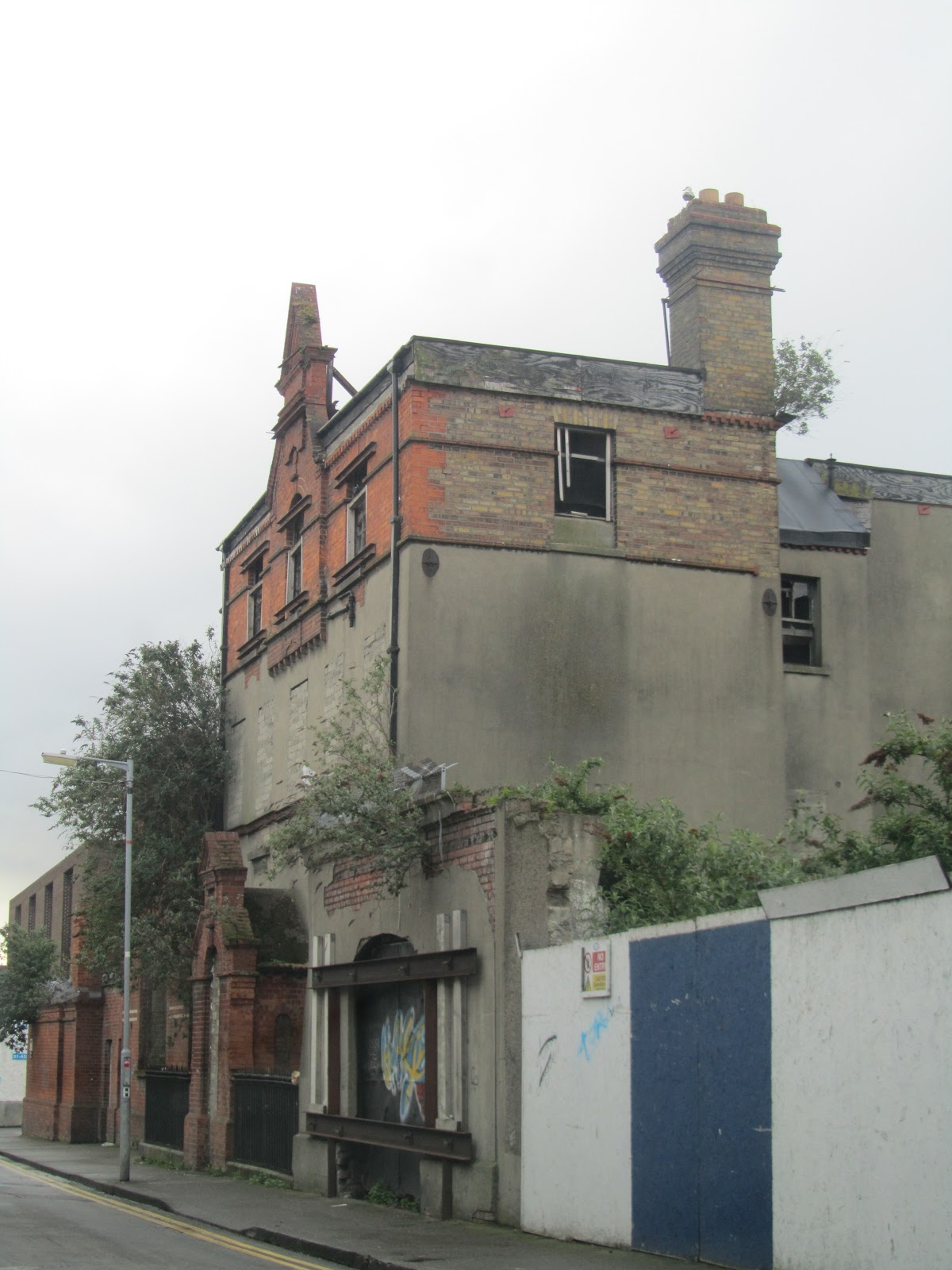
I park my car in the back streets of D8 just South of the Liberties, this morning I was a bit earlier than normal and managed to get a parking on Mill street, the streets were really quite, it was cold and the sun was streaming down, I parked my car and looked up and noticed and old building which I had obviously not noticed before.

 Like quite a few buildings in the area it was all boarded up, but this one looked like it was probably a couple of hundred years old, and must have been quite a grand place in it's time could possibly have been a school. The building half broken down had all kinds of things growing out of every crevice and all that was occupying it were the birds flying in and out feeding their young in their nests. Next to the old building is an abandoned excavation site.

It was so peaceful.  Just down from this building is an old pub that has also been boarded up. I was upset because I hadn't brought my camera in and would have loved to have capture the moment, as I walked down and turned the corner by the pub, a heard the clip clop, clip, clop of a horse - and there before me was a young lad riding a horse drawn carriage, the carriage not in too bad shape was small and black and looked almost like a hearse, it felt like I had suddenly been drawn back 100 years or more with the beautiful silence and only the sound of the horse on a cobble stoned road.


View Larger Map I did a "Google Search" and found some history on the area:

http://www.excavations.ie/Pages/Details.php?Year=&County=Dublin&id=13043

Dublin
2003:556
10 Mill Street, Dublin
Urban post-medieval

Test excavation on a large site at Mill Street, Dublin 8, was undertaken in October and November 2003. The site includes a standing historic structure (10 Mill Street), which was the subject of a separate report.
The development site has frontage to Mill Street, Sweeney’s Lane, and flanks Warrenmount Lane and convent grounds. The development of this area is heavily influenced by the River Poddle, which powered many mills and serviced other industries in the south inner city from the medieval period onwards. The site of the medieval “Double Mill” of St Thomas’s Abbey, with its water channel and millpond, is located on the development site. The millpond (SMR 18:20(398)) was located to the west of the mill and the mill (18:20(92)) was sited towards the eastern end of the site. One channel of the Poddle led north-east around the boundary of the lands of St Thomas, and a mill, known as the Double Mill, was located on this branch. This is located on the site under study.

The first edition of the OS map shows the millpond, fed by the combined sources of the stream from the mill at Greenmount Terrace (annotated the ‘factory water’ on the estate map of the earl of Meath) and another branch down Sweeney’s Lane. The millpond at the site appears to have been visible as late as 1973, when Fitzgerald wrote: ‘it is of special interest to see today – still open and in the centre of Dublin – the Mill Pond belonging to the ‘double mill’ listed above. It is the last open portion of the Poddle still there, within hailing distance of Saint Patrick’s.’ She describes it as ‘about 3ft wide and 2ft deep with no sign of power or history at all, except where it finally cascades underground, under the former old mill at Warrenmount’.

The location of the trenches was determined by the perceived location of historic features, which included the mill building/s (Trench 1), early 18th-century buildings on Sweeney’s Lane (Trench 3) and the edge of the millpond (Trenches 2, 4 and 5). The locations were limited by the presence of live services, a culvert for the Poddle and the presence of standing buildings. All the trenches were excavated by a JCB fitted with a toothed bucket.

Trench 1 was located in the area of the two buildings indicated closest to the millrace on Rocque’s map of 1756. Two discrete groups of industrial features were uncovered in the trench, which measured 2m in width and almost 10m in length. Further investigative work is required in this area. The features uncovered relate to the industrial buildings last present on the site. They are likely to relate to the 19th-century mill on the site, which stood until the 1970s. This large mill building may have incorporated elements from the smaller mill depicted on Rocque’s map. These are likely to include the watercourses and wheel pits. None of these were exposed in the test-trench.

Trench 2, in the yard to the west of the millpond, uncovered a decayed timber pipe or drain. A shard of 19th-century pottery was retrieved from the silt which filled the central perforation of the pipe. The pipe lay on subsoil.

Trench 3 was dug along Sweeney’s Lane. It was expected that evidence for the substantial houses built here by 1718 would be uncovered. Concrete overlay hard-core to a depth of 0.4m. This directly overlay subsoil.
No deposits were uncovered in Trench 4, which was located in the south-western part of the site, close to the west wall of the large modern building. It was expected that the retaining wall/s for the millpond would be uncovered. The trench measured 20m in length. The sides collapsed continuously throughout excavation, due to the unstable nature of the deposits uncovered. The trench was dug to a maximum depth of 2.5m, and the profile was consistent throughout. Very loose stone and brick rubble and loam, which included plastic debris of recent date, was uncovered. No structural features were evident. The material uncovered represents deliberate and rapid infilling of the millpond.

Further archaeological work is planned for this site.
Reference
Fitzgerald, A.D. 1974 Down the old Poddle. In E. Gillespie (ed.), The Liberties of Dublin. Dublin.
Claire Walsh, 27 Coulson Avenue, Rathgar, Dublin 6.

Friday, December 3, 2010

The Big Snow

I decided to search the internet to see when Dublin & Ireland had so much snow before and I came across this article which was really interesting:


AN ACCOUNT OF THE BIG SNOW”
(24TH FEBRUARY 1933)


Monday Night 8.30pm

My Dear M & B,


I hope you are both well and that you did not experience the awful blizzard, which visited us on Friday last. We have just been through the biggest snowstorm in living memory. I believe the last similar one occurred in 1867. I had often pictured in my mind what it would be like to have the roads blocked with snow six to eight feet deep, but now we have the reality.


I believe this storm will rank in the minds of the peasantry with the big wind of 1839 and the lesser one of 1903. It will be a long time until all the episodes of the storm will be narrated and then of course they will all have to be told over and over again.


I should mention of course that we do not know yet how Sissie has faired, but of course we hope for the best.


Now to begin, we were invited down to Brady’s (the shop) for a card game on Thursday evening, but as it commenced to snow about six o’clock Ma and Gretta would not set out. I was glad after that they didn’t as it was snowing heavily at ten o’clock and eleven and we would have got it very hard to get home.
On Friday morning we awoke to find the ground covered with snow, only about an inch, however, and it was not snowing then. When we were eating our breakfast at nine o’clock it commenced to snow again, rather fine snow with a driving north wind.


I started out to school and was overtaken by Mrs. Kelly at Peter Garvey’s Cottage, she was a sight. Her coat and hat being covered with frozen snow. As we proceeded down the exposed portion of the road, we felt the full force of the icy blast and I was forced to cover my ear with my hand as I could not stand the cold.
Fourteen children answered the roll call and I made up my mind that I would dismiss them at 12 o’clock, I expected the priest down then to hear confessions. We could see through the school windows that it was snowing heavily all the time and that the wind had increased but we had no idea it was so awful outside.
At 12 o’clock the children got their cocoa and I went round to the little house to tell Mrs. Kelly and Miss Plunkett that I would let them home. At this time it was impossible to see more that two yards ahead of you on the road and as I was going into the school again I thought I saw a load of fodder or something at the churchyard gate. On closer investigation it proved to be a mound of snow about seven feet high.
I then marshalled the kids and told them how to proceed on the homeward journey. I gave them strict instructions to keep together and to go into the nearest house when they could proceed no further.
Peter Gaynor called in then and said that he got it very hard to get down. He took his own children in tow and also all who were going his way. Sissie Reilly went with him too and as she was to go up to Keogh’s for the milk, I told her to wait for me at Keogh’s gate. 


I then locked up, muffled up and proceeded homewards with two wee cans of water from the pump. The snow was heaping up on the left hand side of the road and even on the right side it was 10 feet deep in places. I was almost winded when I got to Keogh’s gate and was glad of the shelter. I saw that there was a small tree right across the road a few perches ahead.


Since Sissie Reilly was not appearing I had to go up to Keogh’s for her. The yard was filled with Sheep and Cattle all covered with snow, the weirdest thing you ever saw. Sissie Reilly and I then started for home. When we got on to the road we honestly could not see one yard ahead of us with the driving snow, while the icy wind almost took our breath away. I got the wind up in more senses than one and Sissie Reilly became hysterical. I judged it better to stand awhile to draw our breath. Thus fortified we started off again, often floundering through snowdrifts two and three feet deep. 


At last Peter Gaynor’s cottage loomed ahead and I went into see did they all get home safely and what became of the two Mulvany’s from Seymourstown who had also been at school. I found that Peter had them inside and I took them up to our house. I met Paddy Nulty starting out to meet Sissie and when he left Sissie in, he came up after me to tell me how he was going down to tell me not to let out the children until someone called for them.


I then got the wind up about three children who had to go on beyond the little new cottage on the Virginia Rd. Station road. I know that if they were overcome I would be partly to blame. Paddy Nulty volunteered to inquire after them as he had to go down to tell the postman that he could not drive him into Kells.
I could hardly eat my dinner with the excitement of my journey home and my anguish about the children. However, Paddy Nulty reappeared in about an hour and a half with the following story.


He found that the two girls remained in Finnens but that the little fellow had started out on his own! Paddy then started out with the two girls (I should mention that Frances Nulty was with them too). They inquired at Daly’s and found that young Walshe had passed there anyway. They then entered the next collage and found him sitting at the fire. It appears he went on a little farther but getting a bit bogged had the good sense to come back.


The Nulty’s, having collected him, started out again, but on being confronted with a wall of snow ten feet high, they returned and defrosted the children in the last mentioned cottage. They were not removed from there until 9.30 that night although within a quarter of a mile of their own home. This story eased my mind regarding the children and I started to enjoy the comforts of a good fire. I should mention that I gave Paddy Nulty a glass of whisky for his trouble. I had a mouthful when I came home myself as I was shivering like an aspen, not so much with the cold as with fright.


Gretta in the meantime was looking after the needs of our two protégés. Their father arrived about half four, dead beat. It took him three hours to do the journey and he was nearly lost in a snowdrift at Johnny Smiths gate. It appears he began to shout for help on approaching our house but of course was not heard above the howling of the storm. We could not of course allow him face home again and so we had three for the night. 


The back door could not be opened with all the snow that was against it (it opens out you know) and so I went out with a shovel to relieve matters. I found no table, no paraffin tanks, but a big heap of snow up to the latch of the door. I had a nice job to shovel it away while the storm still raged. The open shed was filled almost to the roof with snow while there was about a foot of snow on top of the car in the shed. The house had a peculiar appearance on the outside, every window was completely blocked up with snow and there was a fringe of snow about six inches wide all round the frames of the front door. Mrs. Kelly and Miss Plunkett got as far as Keoghs where they remained for the night. The postman remained in his little tin hut all night. It was very weird to be sitting inside at the fire listening to the howling of the storm, while we could see nothing, as all the windows were blocked up with snow. 


The hens did not put even their beaks out all day. They had to be fed inside in their house and locked up again immediately, they only got one feed. As poor Judy and Pearl would have no place to lie outside they were kept indoors, both that night and the next and I must say they behaved very decorously indeed.
Ma and in fact we all were troubled about Sissie, afraid she would be so foolish as to try and brave the storm in her endeavours to reach Piercetown. As I said before we do not yet know how she fared. The storm eased off about nine o’clock. We heard on the wireless that it was pretty bad in Dublin too. All traffic stopped etc.The Shannon Scheme Wires were broken down, all communication with the provinces was cut off both by road, rail and wire and there were several pathetic S.O.S’s.


Well we slept but on Saturday morning what a sight met our eyes when we ventured forth. I should say here that I was up and out at 8 o’clock and after a preliminary survey I armed myself with a shovel and started to excavate passages from the various doors and sheds etc.


The road from our house to Peter Gaynor’s was pretty clear, there being only about two feet of snow on it, but from the pump right across the road to Nulty’s garden, there was a hill of snow seven feet high at least. I could not look across it. This hill continued up to John Lynch’s shed, here there was a valley and beyond that again the snow was eight feet deep almost to Brennan’s Cottage. The surface of the snow was not level, but in places took on the most fanciful shapes like curling waves or the curved backs of old fashioned furniture. 


On the Chapel side the snow become deep below Gaynor’s Cottage and from that down to Keogh’s was eight feet deep all the way. Neddy Quinn from Barney Hill was the first wayfarer to pass by. He was going to look after Cattle at Condy’s Cross. It took him three hours to reach our house and as he breasted the snowy waves armed with a short shovel, which he plunged in the snow at every step, he looked like an intrepid Polar explorer or a bold Swiss Mountaineer. Mrs. Kelly came next escorted by Johnny Keogh (Miss Plunkett faced home across the fields with another escort), then came the postman, trudging his weary way to Kells. Paddy Nulty and I then faced for Finnens for water and of course cigarettes, I resurrected by leggings for the occasion.


It was comparatively easy to walk on top of the snow and in places we walked into the fields and on to the road again just for the fun of it. From Keoghs to Finners the road was not too bad and on the left side of the road there was a pass all the way only about one foot deep. When we arrived, old Finnen was busy cutting a pass from the shop door to the pump. Here the snow was 2 feet deep.

Tuesday 3.00 pm
The children’s father faced home after breakfast on Saturday morning, but he did not bring them with him so we had them on Saturday night too. After dinner on Saturday Gretta and I faced for the well at Brennan’s. We had quite an exciting journey and while the snow was for the most part hard, we now and again sank down to our knees. Barney called down to see us. He said that the road from his house to Condy’s Cross was even worse than ours.


The question now was how long would the snow remain and how long would the food supply hold out. Well we were lucky to have a good supply of bacon, butter, tea, sugar, flour and some bread, while we could procure fresh mutton from Keoghs.


I had to dispense some bags of coal to the neighbours so as to keep the home fires burning. On Sunday morning we were up betimes, but the snow had abated very little. We were not sure whether the priest could come or not and we were in and out watching him.


We could see the people walking across the snow clad fields from Balgree and Ballyhist and then a lot of people appeared in the field beyond Nulty’s garden (it was easier to go by the fields). Then Father Drake appeared breasting Mt. Blanc at John Lynch’s shed and behind him in single file came 15 or 20 others. 
Gretta and I went down to mass which was short and sweet. We met Mickie after mass and he told us that both Matt and Alick were again confined to bed and that Alicks breathing was a bit short. Matt too is very feeble and has to be helped in and out of bed. They have a hard job nursing them both. Unfortunately I cannot go over to see them until the snows clear. We sent the two Mulvany’s home with their friends after mass on Sunday. I went down to school on Monday, but only a few scholars turned up so I packed them home again. I did the same to-day (Tuesday). It is much harder to travel to-day as the snow is soft and treacherous and I’m thinking it will be even worse to-morrow.

Some Items of the Storm:
The children set “elephant” traps in the snow and were well rewarded to see some travellers plunge into them.


Gaynor’s white goat did not become visible until Monday, she was covered up in a drift alongside our field. She is going strong.


Keogh’s had a goat, which only thawed out yesterday also they had been walking across her for two days in a big drift. She also is alive.


A few fields over beyond Nulty’s a bullock was smothered in a huge snowdrift. Several people had to dig sheep and lambs out of the snowdrifts.


I don’t know how the poor birds survived the storm but anyway they turned up quite perky on Saturday morning and gladly availed themselves of the crumbs we put in the window sills. 


We have, or rather the Nulty’s have, rediscovered a new well down a bit from John Lynches shed. It may turn out useful now that the pump is undrinkable. 


All roads from Dublin are passable to-day, except the Dublin to Kells road. The postman walked out from Kells to-day, but I hadn’t my letter ready for him. In any case it would get no farther than Kells as the Dublin road is blocked and the trains are not running on account of the railway strike. 


In front of our door the snow was level with the window sill. Some of the fields were hardly covered with snow while all the roads were blocked. It is raining heavy now (3.30pm Tuesday) so that will cause the snow to melt much faster. 


Katie Keogh was to have been married in Dublin this morning to a man called Fallon, a native of Multyfarnham. He has a garage in Clare Street, Dublin. Father Lynam was to go up to marry them and Mrs. Keogh, Johnny, young Seán and Miss Plunkett were to be there too. I suppose the wedding had to be postponed. Katie herself is in Dublin and may, however, have been married. 


Father Drake was saying mass in Johnny Tully’s on Friday morning. He had to leave his car there on the road and walk home. Several cars were snowed up between here and Oldcastle. Lynch’s big Lorry was the last car to pass on Friday morning. We shall anxiously await its return from Oldcastle, as it will be the dove with the olive branch, which will show us that the snow has abated from the face of the roads.


I hope Jimmie has by this time recovered from the flu. I suppose he is in the continent by this time. You cannot say at any rate that this is a short letter or an uninteresting one. I hope it will absolve me from writing again until after Easter in any case. Am not posting until tomorrow, Wednesday.


Your affectionate brother
Patsy


Late News:
The postman has just arrived with your weekly bulletin. We were glad to note that you all got over the storm ok. No word has arrived from Sissie yet. I am dropping her a line now as postal communication has been restored.


G and I were at mass this morning. We brought some ashes home to Ma. No school today either. We heard there were 9 or 10 lives lost in the storm. It is reported that 5 children were lost in the storm but the report is not confirmed. It appears Dr. Mulvany, our bishop, was on his way from Navan to Athboy on Friday last. He was forced to take refuge in a little shop outside Athboy (it must be near Moyaugher) and stayed there all night. He is still held up in Athboy. We heard to-day that K. Keogh may have been married as Fr. Drake walked into Kells and wired instructions to proceed with the marriage.


So long
Patsy


There is still 3 feet of snow on the road to chapel.


Courtesy of Ballinlough-Kilskyre Historical Society

Sunday, September 5, 2010

Interesting ...

I was reading some fascinating accounts on Monsoons blog today on history of Europe and the black plaque, so now going to start studying some more history and learn about Europe's history seeing as we were never taught this in school.  But something else I found on Monsoons blog which I stole was a saying by Mark Twain:


"Twenty years from now you will be more disappointed by the things that you didn't do than by the ones you did do. So throw off the bowlines. Sail away from the safe harbour. Catch the trade winds in your sails. Explore. Dream. Discover"


So true.